Pin, magnet, clip or lanyard: what holds up on which uniform
Use a magnet on anything you do not want holes in: knit polos, blouses, blazers, silk. Use a pin on heavy cotton, denim, aprons and coveralls where a magnet can shear off. Use a clip when the badge moves between people or garments during a shift, and a lanyard when the badge has to be scanned or read from a distance.
Reference guide, reviewed 2026-08-20
Fabric to backing
| Garment | Best backing | Why |
|---|---|---|
| Knit polo | Magnet | A pin stretches and eventually holes the knit |
| Dress shirt or blouse | Magnet | No pinholes, sits flat, easy to move between shirts |
| Blazer or suit jacket | Magnet or pin | Lapel fabric is heavy enough for either |
| Heavy cotton apron | Pin | Thick fabric weakens magnet hold |
| Denim or canvas work shirt | Pin | Weight and movement pull magnets loose |
| Scrubs | Clip or lanyard | Scrub tops are thin, and badges get swapped often |
| Chef coat | Pin | Double breasted fabric is too thick for a magnet |
| Event T shirt | Clip or lanyard | Single layer knit tears under a pin |
| Fleece or sweater | Pin | Loose weave lets a magnet shift and drop |
Backing tradeoffs
| Backing | Hold | Garment damage | Watch out for |
|---|---|---|---|
| Two bar magnet | Strong on thin to medium fabric | None | Keep away from pacemakers, ICDs and hotel key cards |
| Military clutch pin | Very strong | Two small holes | Backs can be lost, order a few spares |
| Bar pin | Strong | One line of pinholes | Not for knits or single layer tees |
| Swivel or bulldog clip | Medium | None | Slides on thin fabric, can flip face inward |
| Lanyard with holder | Medium | None | Snag risk near machinery, use a breakaway |
| Adhesive | One shift | None | Single use, best for visitors and events |
The magnet safety rule worth writing into your policy
Badge magnets are strong enough to matter around implanted cardiac devices. Anyone with a pacemaker or defibrillator should wear a pin or clip instead, and that choice should be available without anyone having to explain why. Keep magnetic badges away from hotel key cards and older magnetic stripe cards as well, since sustained contact can wipe them.
Food service and healthcare have their own habits
In kitchens and food prep, the concern is a backing coming loose into food. A magnet with two bars sits flat and has no pin to drop, which is why so many restaurant groups standardize on it. Wipe down badges instead of soaking them, and keep a small stock of replacements at the store, because badges do get bent and lost.
In healthcare, badge holders and reels usually win because ID gets scanned and shown all day. Photo ID goes on the reel and the printed name badge goes on the chest where a patient can read it from the bed.
Ordering spares is cheaper than a rush order
Clutch backs and magnet bars fail at a low but steady rate. On a 100 person rollout, buy a handful of extra blanks or a small run of common first names for new hires. Standard production runs 5 to 8 business days, rush runs 1 to 3, so a small buffer avoids paying for speed later.
Questions we get on this
Are magnetic name badges strong enough for a full shift?
On knit polos, dress shirts and blazers, yes. A two bar magnet holds all day. On denim, canvas, chef coats and heavy aprons, use a pin instead.
Do magnetic badges damage clothing?
No. That is the reason most uniform programs move to magnets. Pins leave holes, magnets leave nothing.
Who should not wear a magnetic badge?
Anyone with a pacemaker or an implanted defibrillator. Give those employees a pin or clip backing, and keep magnets away from key cards and magnetic stripe cards.
Products referenced in this guide
Magnetic Name Badges
as low as $6.49 per badge at 1,001+
Premium Name Badges
as low as $9.99 per badge at 1,001+
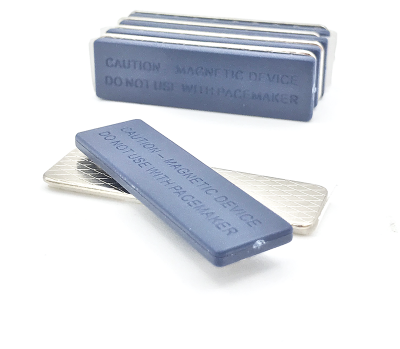
Badge Accessories, Magnets and Pins
Related guides
Name badge size chart, with how many characters actually fit
The four sizes that cover almost every order are 1 x 3 inches, 1.5 x 3 inches, 2 x 3 inches and a 2.25 x 3 inch oval. A 1 x 3 badge holds a first name in large type plus one short line under it. Go to 1.5 x 3 the moment you need a full name, a title and a logo on the same badge.
Badge materials compared: plastic, aluminum, solid metal, wood
Printed plastic is the cheapest per badge and the fastest to reorder, and it looks new for roughly a year of daily wear. Brushed aluminum with full color print costs a little more and holds its finish longer. Engraved solid metal has no printed layer to wear off at all, which is why uniform and service tags are made that way.
Ready to design your badges?
Use the online designer to build your badge, or send us your list and we will quote it today.